

Created By: Chase Woodard
Enterprise AI Agent Governance — Everything You Need to Know
A vendor-neutral framework for deciding what agents may do, proving that they work, & keeping people accountable for the outcomes.
Table of Contents
- Overview
- Strategy & Design Decisions
- Reference Architecture & Runtime Flow
- Core Components
- Prerequisites & Pre-Checks
- Configuration & Governance Lifecycle
- Validation
- Troubleshooting
- Best Practices
- Conclusion
Overview
AI agents are software systems that can interpret a goal, choose steps, use tools, & take actions across business applications. A chatbot might answer a question. An agent may read a support ticket, look up account data, draft a response, update a CRM record, & escalate the case when policy requires a person.
That difference matters. Once software can act, governance cannot stop at choosing an acceptable model or writing a good prompt. Leaders need to decide which jobs are appropriate, who owns the outcome, what data & tools the agent can access, when approval is mandatory, how performance is measured, & how the agent is stopped or rolled back.
Think of an AI agent like a new digital employee operating at machine speed. You would not give a new hire access to every system, let them invent company policy, or allow them to approve their own exceptions. You would define the role, train them, limit access, supervise early work, review results, & expand responsibility only after evidence supports it. Agent governance applies the same operating discipline through technical controls & auditable processes.
Why Governance Matters Now
Recent releases illustrate several common approaches to operating agents in production. OpenAI’s published approach emphasizes bounded jobs, simulations, evaluations, guardrails, & controlled change. Cloudflare’s published approach emphasizes tracing, replay, human approval, identity, access control, & observability. These examples show different implementation patterns; they are not endorsements or independent validation of either platform.
Standards & security organizations are moving in the same direction. NIST’s AI Risk Management Framework organizes voluntary risk management around governance, mapping, measurement, & management, while its 2026 AI Agent Standards Initiative focuses on agent identity, authorization, interoperability, & security evaluations. OWASP’s Top 10 for Agentic Applications provides a practical security starting point for systems that plan & act across complex workflows.
For business leaders, the takeaway is straightforward: the value of an agent is not merely what it can generate. The value is what it can complete safely, repeatedly, & visibly inside an accountable operating model.
When to Use an AI Agent
An agent is a good candidate when the work:
- Has a clear objective & recognizable completion state.
- Uses defined systems, data sources, & actions.
- Repeats often enough to justify design & oversight.
- Can be evaluated using observable quality & risk criteria.
- Has exceptions that can be routed to a person.
- Can be paused or reversed when something goes wrong.
An agent is a poor fit when the work depends on unclear authority, hidden context, irreversible high-impact actions, unsupported legal or compliance judgments, or outcomes that cannot be measured. In those cases, use a recommendation assistant, a human-led workflow, or conventional deterministic automation instead.
Strategy & Design Decisions
Start With a Job, Not a General-Purpose Agent
The safest & most useful starting point is one bounded job: triage incoming requests, reconcile two data sets, prepare a weekly operating report, or route approved records between systems. A common production pattern is to limit the agent’s knowledge, tools, & system access to what that specific job requires.
A good agent charter answers six questions:
- What business outcome should this agent produce?
- Who owns that outcome?
- What inputs may it use?
- What actions may it take?
- Which decisions require human approval?
- What evidence proves success or failure?
If those answers are vague, the agent is not ready for production.
Choose the Right Autonomy Level
Autonomy should be assigned by action, not by branding the whole agent as “autonomous.” The Digital Nomads framework proposed in this article uses four practical levels:
- Recommend: Produce analysis or a proposed action for new or high-risk workflows.
- Prepare: Create drafts or stage changes for repetitive work that still needs review.
- Act with approval: Execute only after an authorized person approves material, customer-facing, financial, or access-changing actions.
- Act within policy: Execute low-risk, reversible actions inside strict limits after the workflow has strong evidence & monitoring.
A single workflow may use all four. The agent can automatically classify a request, prepare a response, require approval before issuing a refund, & autonomously add an internal tag.
Separate Business Policy From Model Behavior
Prompts express intent; they do not enforce authority. A common security pattern is to enforce access in the agent harness, identity layer, tool gateway, & network path where actions occur—not in text that a model can reinterpret or be manipulated into ignoring.
Business rules should therefore live in controlled policy, workflow, identity, & approval systems. Examples include:
- Maximum transaction values.
- Approved recipients & destinations.
- Allowed data classifications.
- Read-only versus write permissions.
- Working hours or geographic restrictions.
- Required reviewers for high-impact actions.
- Conditions that force escalation or shutdown.
The agent may explain these rules, but it should not be able to rewrite them during a run.
Define Success Before Selecting a Vendor
A platform comparison is useful only after success criteria are clear. Evaluate options against the job’s requirements for identity, tool control, policy enforcement, evaluation, observability, data handling, portability, cost, support, & rollback. A compelling demonstration is not evidence that the system can operate safely in your environment.
Reference Architecture & Runtime Flow
An enterprise AI agent is not just a model connected directly to business applications. A production design surrounds the model with input validation, approved context, identity, policy enforcement, human approval, controlled tool access, outcome validation, & audit evidence. The logical architecture below is vendor-neutral; a specific platform may combine or separate these functions differently.
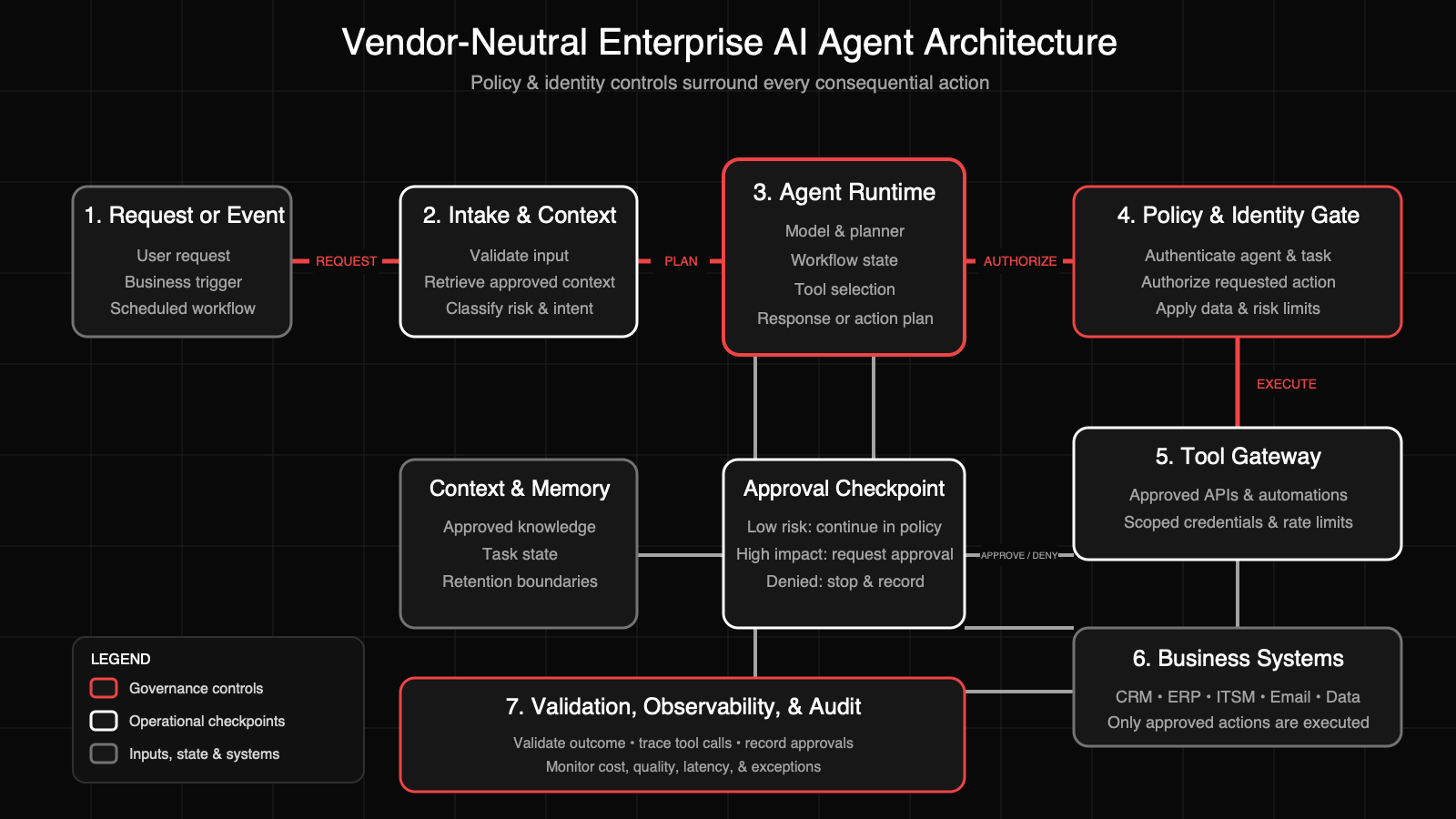
How a Request Moves Through the Agent
- Receive & validate the request. A user request, business event, or scheduled trigger enters through a defined interface. The intake layer validates the input, identifies the requesting identity, rejects malformed or prohibited requests, & assigns the task to an approved workflow.
- Retrieve approved context. The system gathers only the knowledge, records, & task state required for that job. Retention, tenant, privacy, & data-classification boundaries apply before the model receives context.
- Plan the work. The agent runtime interprets the objective, proposes steps, selects from approved tools, & maintains workflow state. The model can propose an action, but it does not grant itself authority to perform it.
- Evaluate identity & policy. The policy layer checks the agent identity, task identity, requested action, destination, data scope, risk level, & current workflow state. A denied action stops & is recorded.
- Request human approval when required. Low-risk actions may continue inside policy. Material, customer-facing, financial, destructive, or access-changing actions pause until an authorized person approves the exact action.
- Execute through a controlled tool gateway. Approved API calls & automations use scoped credentials, rate limits, destination restrictions, & explicit tool contracts. The agent does not receive unrestricted access to each business system.
- Validate & record the outcome. The system confirms whether the action completed correctly, records tool calls & approvals, measures quality, cost, & latency, & routes failures or exceptions for investigation.
The return path matters as much as the forward path. Tool results become controlled workflow state, not unquestioned truth. The agent may revise a plan or request additional approval, but it should not silently expand its permissions, rewrite policy, or modify its own production controls.
Core Components
The Digital Nomads operating model proposed here has eight connected components.
1. Business Owner
The business owner is accountable for the outcome, acceptable error rate, customer or employee impact, & continued need for the agent. Technology teams can operate controls, but they should not become the default owner of every business decision an agent makes.
2. Agent Registry
Maintain a current inventory containing:
- Agent name & purpose.
- Business & technical owners.
- Model, platform, & major dependencies.
- Connected data sources & tools.
- Approved actions & autonomy levels.
- Risk classification.
- Production version & change history.
- Last review date & retirement owner.
An unregistered agent should not receive production credentials.
3. Identity & Access Control
Give each agent & task a distinct identity. Avoid shared human accounts & broad, long-lived credentials. NIST’s AI Agent Standards Initiative identifies authentication & identity infrastructure as a central requirement for secure human-agent & multi-agent interactions.
Access should be:
- Least-privileged.
- Scoped to the job & environment.
- Short-lived where supported.
- Attributable to the initiating user or process.
- Restricted by action, resource, tenant, & destination.
- Revocable without disabling unrelated systems.
A common least-privilege pattern binds authority to a task & evaluates each action against the task, approved policy, & current state. The durable principle is vendor-neutral: grant the smallest capability needed for the shortest useful period.
4. Tool & Data Boundary
List every system the agent can read or change. For each connection, document the data classification, allowed operations, expected volume, retention, & egress rules. A CRM search, payroll update, email send, & infrastructure change are not equivalent actions & should not share one approval policy.
5. Policy & Approval Engine
Translate business rules into enforceable decisions. Define what is automatically allowed, automatically denied, or held for review. Approvals should show the proposed action, relevant context, expected impact, & who requested it. Avoid approval fatigue by reserving human review for meaningful exceptions & consequential actions.
6. Evaluation & Test System
An agent needs a repeatable test suite, not a one-time demonstration. Common approaches include simulations, evaluation sets, & graders that test normal requests, ambiguous cases, prohibited requests, stale or conflicting data, tool failures, permission failures, prompt injection, policy adherence, & escalation behavior before controlled rollout.
7. Observability & Audit Trail
Capture enough evidence to reconstruct what happened:
- Request & initiating principal.
- Agent, policy, prompt, & workflow versions.
- Data sources & tools used.
- Proposed & completed actions.
- Approval events.
- Errors, retries, & escalations.
- Outcome & quality signals.
- Cost, latency, & volume.
Across current agent platforms & operating models, common observability controls include run tracing, replay, tool-call logs, approval records, identity attribution, outcome metrics, & live monitoring. The specific implementation varies by platform, but the operating requirement is the same: consequential actions must be inspectable & attributable.
8. Incident, Change, & Retirement Controls
Every production agent needs a stop mechanism, incident owner, communication path, rollback method, & evidence-preservation procedure. Changes to models, prompts, tools, policies, data sources, or approval rules should be versioned & tested. Retirement must revoke credentials, disable triggers, preserve required records, & confirm that downstream automations no longer depend on the agent.
Prerequisites & Pre-Checks
Before a pilot begins, confirm:
- A named business owner & technical owner exist.
- The job, boundaries, & exclusions are documented.
- Data owners approve the intended access.
- Security & privacy review requirements are known.
- The target systems expose appropriate roles or scoped APIs.
- A baseline human or existing-process performance measure exists.
- Test cases include normal, edge, adversarial, & failure scenarios.
- Human escalation & approval channels are staffed.
- Logs can be retained & reviewed without exposing unnecessary sensitive content.
- The agent can be paused & its changes can be reversed where required.
- Vendor contracts, data handling, model retention, & support responsibilities have been reviewed by the appropriate owners.
NIST positions AI risk management as a continuous practice that incorporates trustworthiness into design, development, use, & evaluation rather than as a final compliance check. NIST also states that AI RMF 1.0 is currently being revised, so teams should confirm the latest version before binding internal policy to a specific revision.
Configuration & Governance Lifecycle
Step 1: Map the Workflow
Document the current process from trigger to completion. Identify systems, people, data, decisions, delays, failure modes, & existing controls. Mark which steps are deterministic & which require judgment.
Expected result: a workflow map with one bounded agent role & clear human ownership.
Stop condition: the team cannot agree on the process, authority, or definition of done.
Step 2: Classify Actions & Risk
Score each proposed action by impact, reversibility, data sensitivity, external visibility, financial effect, & regulatory significance. Set the autonomy level for each action.
Expected result: an action matrix showing allow, deny, approve, & escalate paths.
Stop condition: high-impact actions lack an accountable approver or rollback method.
Step 3: Establish Identity, Access, & Data Boundaries
Create dedicated identities, minimum roles, approved destinations, & secret handling. Enforce boundaries in the tool & network layers rather than relying on instructions in the prompt.
Expected result: the agent cannot access an undeclared system or perform an undeclared operation.
Stop condition: the deployment requires a shared administrator account or unrestricted credentials.
Step 4: Build Policies & Human Handoffs
Encode operational limits & define escalation routes. The human reviewer should receive enough context to make a decision without reconstructing the entire run.
Expected result: risky or ambiguous actions pause cleanly & reach the correct owner.
Stop condition: the workflow continues after an approval timeout or treats silence as consent.
Step 5: Test in a Controlled Environment
Run a versioned evaluation set using realistic but approved test data. Include failed tools, malicious content, conflicting instructions, stale knowledge, duplicate events, & partial outages.
Expected result: results meet agreed thresholds, prohibited actions are blocked, & failures remain contained.
Stop condition: the team cannot reproduce an outcome or determine why an action occurred.
Step 6: Release Gradually
Begin with recommendation or preparation mode, a small user group, limited data, & low-risk actions. Expand only when evidence supports the next step.
Expected result: production behavior matches evaluation results within agreed tolerances.
Stop condition: unexplained drift, missing logs, control bypasses, or rising exception rates.
Step 7: Monitor, Review, & Improve
Review quality, incidents, approvals, denials, cost, latency, user feedback, & business outcomes. Proposed changes should pass the same test & approval process as the original release.
Expected result: every active agent has a current owner, evidence, & review date.
Stop condition: the agent’s value, control effectiveness, or ownership can no longer be demonstrated.
Step 8: Retire Safely
Disable triggers, revoke credentials, archive required evidence, remove obsolete integrations, update documentation, & verify that no downstream process still depends on the agent.
Expected result: the agent can no longer act & the business process has an approved replacement or manual fallback.
Validation
Use observable acceptance criteria across five layers:
- Business: Does the agent complete the intended job, & is the outcome useful?
- Policy: Are prohibited actions denied & approval rules enforced?
- Identity & data: Can every action be attributed, & is access limited to approved resources?
- Technical: Are tool calls, retries, failures, & state transitions reliable & visible?
- Operations: Can the team pause, investigate, roll back, & recover the workflow?
A final production-readiness check should prove:
- Every agent has named owners.
- Every action has an autonomy level.
- Every production credential is attributable & revocable.
- Every consequential action is logged.
- Approval paths work under normal & timeout conditions.
- Evaluation cases cover business, security, & failure risks.
- Monitoring detects control failures & unusual behavior.
- Incident & rollback procedures have been rehearsed.
- Change history is versioned.
- Retirement can be completed without orphaning a business process.
Troubleshooting
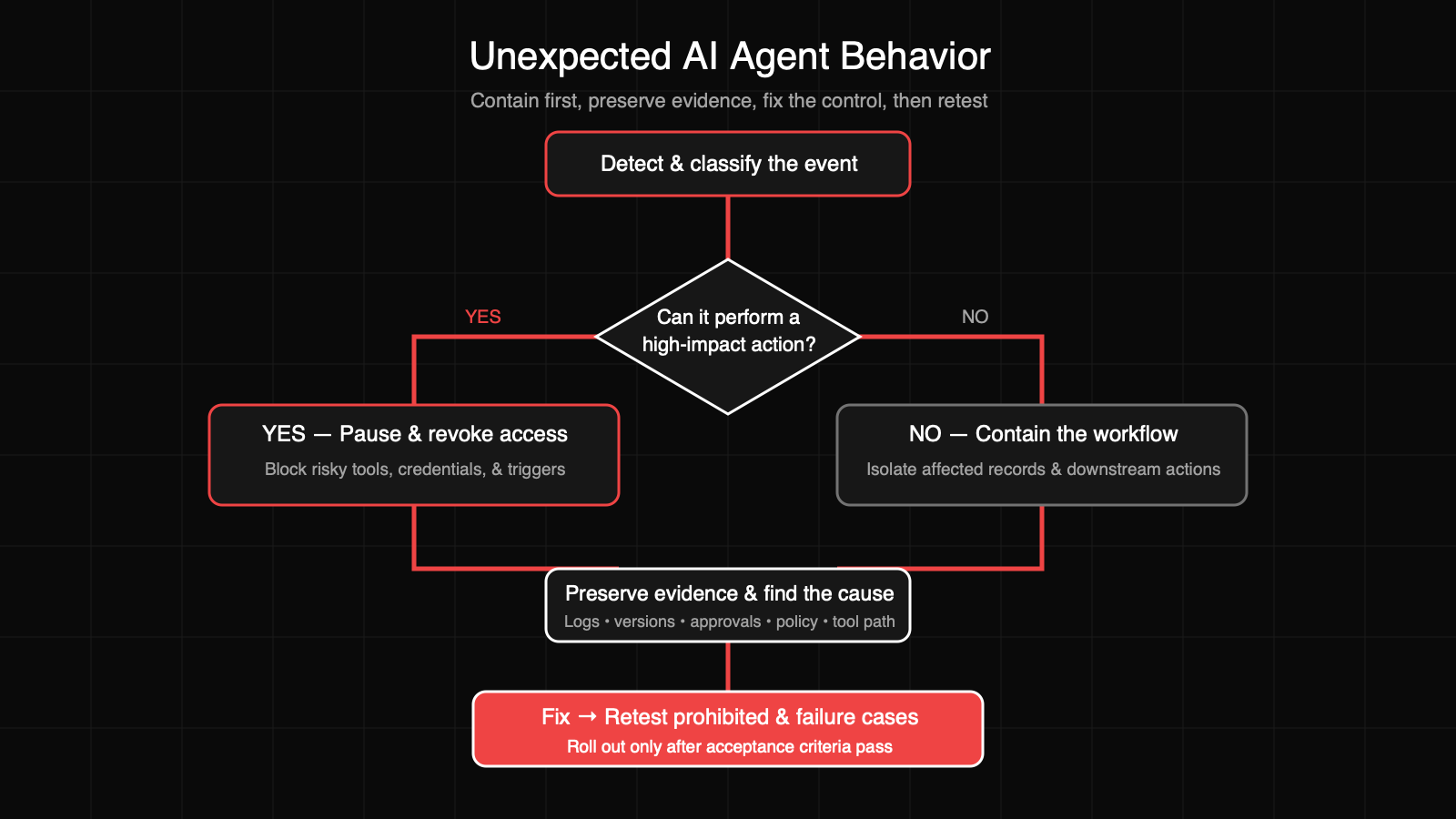
Symptom: The Agent Takes Actions Outside Its Intended Role
Likely causes: permissions are broader than the job, policy is expressed only in prompts, or tools expose unrestricted operations.
Response: pause the agent, preserve evidence, revoke or narrow credentials, inspect the exact tool path, add enforceable policy, & rerun prohibited-action tests.
Symptom: Reviewers Approve Without Understanding the Impact
Likely causes: approval requests lack context, arrive too often, or combine several actions.
Response: reduce approval volume, present one material decision at a time, show affected systems & records, & require explicit rejection or timeout behavior.
Symptom: The Same Request Produces Inconsistent Results
Likely causes: model or prompt changes, unstable source data, hidden tool state, or missing evaluation coverage.
Response: compare versions, replay the run when supported, pin controlled components, add the case to the evaluation set, & verify source freshness.
Symptom: Nobody Can Explain Why an Action Happened
Likely causes: incomplete logging, shared identities, missing version data, or multi-agent delegation that lost the initiating principal.
Response: stop high-impact actions, restore end-to-end attribution, log policy & tool decisions, & reject runs whose audit chain is incomplete.
Symptom: The Agent Is Safe but Produces Little Business Value
Likely causes: the job is poorly chosen, the agent handles too little of the workflow, or success measures focus on activity rather than outcomes.
Response: revisit the workflow map, measure cycle time & completion quality, remove unnecessary handoffs, or replace the agent with simpler automation when appropriate.
Best Practices
- Govern the job & action, not only the model.
- Keep business ownership separate from technical operation.
- Prefer narrow, task-specific agents over broad digital generalists.
- Start with reversible, observable work.
- Enforce boundaries outside the prompt.
- Use separate identities & minimum permissions.
- Require evidence before increasing autonomy.
- Make human approvals meaningful rather than constant.
- Version prompts, models, policies, tools, & evaluations together.
- Treat logs & replay as operational requirements.
- Review active agents on a schedule & after material incidents.
- Maintain a manual fallback for critical workflows.
- Retire agents whose ownership, controls, or business value cannot be demonstrated.
A useful governance principle is to move people from repetitive execution toward accountable orchestration: people set the objectives, guardrails, approval rules, & success measures while agents operate inside those boundaries. Humans remain accountable for the boundaries & outcomes even when software performs the work.
Conclusion
Enterprise AI agent governance is the operating system around an agent. It defines the job, ownership, authority, evidence, approvals, monitoring, change process, & exit path that turn a promising demonstration into a manageable business capability.
The most important design decision is to start small & explicit. Choose one job. Name the owner. Classify every action. Limit access. Test normal & hostile conditions. Observe every consequential step. Require approval where the impact deserves it. Expand autonomy only after production evidence shows that the controls & outcomes are working together.
The technology will continue to change. The governance model should be durable enough to handle new vendors, models, protocols, & current events without rebuilding accountability from scratch.
Subscribe to Digital Nomads Insights for practical guidance on AI agents, automation, infrastructure, & modern operations.
Sources
- Cloudflare: Everything We Launched During Agents Week
- Cisco AI Workforce Consortium: AI Agents and the Impact on Cybersecurity
- OpenAI: Introducing OpenAI Presence
- NIST: AI Risk Management Framework
- NIST: AI Agent Standards Initiative
- OWASP: Top 10 for Agentic Applications for 2026
- Cloudflare: The Agent Access Model